
1. Introduction: Why ERM tools matter in 2026
In 2026, enterprise risk management (ERM) is operating in an environment of rapid disruption rather than incremental change. Economic fragmentation, geopolitical uncertainty, regulatory divergence, and rapid technological shifts have weakened many of the assumptions that once underpinned stable risk frameworks.
In research that's very relevant in 2026, the Aon Risk Maturity Index (RMI) found that organizations with more mature risk management practices consistently perform better and are more resilient in times of uncertainty. They have stronger stock price performance, lower share price volatility, and higher market valuations. These organizations also respond more resiliently to major external shocks and benefit financially through lower Directors & Officers insurance premiums.
In this context, the risk of relying on static models and historical patterns has itself become a material concern. Boards and executives increasingly expect ERM to support forward-looking judgement — helping organizations understand how risks may evolve, interact, and reshape strategic choices. Modern ERM tools are responding to this shift by enabling more dynamic risk assessment, clearer visualization of cause-and-impact relationships, and practical scenario analysis. For leaders evaluating ERM software in 2026, the challenge is not simply selecting a system to document risks, but choosing a platform capable of supporting decision-making in a period of genuine transformation.
Against this backdrop, evaluating ERM tools in 2026 requires moving beyond feature checklists to focus on the capabilities that enable real-world decision-making under uncertainty.
This article assumes a foundational understanding of the concepts of ERM. If you'd like more background first, you may wish to read Risk Management 101: The Complete 2026 Guide.
2. 8 Capabilities to Look For in an ERM System
Not all ERM platforms are designed for the realities that organizations face in 2026. Beyond basic risk registers and reporting, effective ERM tools must support decision-making in environments characterized by change, uncertainty, and strategic trade-offs. The following capabilities reflect what risk leaders and executives should focus on when evaluating ERM systems today, particularly where the goal is to make risk management practical, relevant, and actionable.
| # | Capability | What It Is | Why It Matters |
|---|---|---|---|
| 1 | Strategy and Objective Alignment | The ability to link risks directly to strategic objectives, priorities, and outcomes. Foundational in ISO 31000 and COSO. | Aligning risk with strategy ensures ERM informs real decisions rather than operating as a check-box compliance exercise. |
| 2 | Flexible Organizational Modelling | Support for changing organizational structures, reporting lines, and responsibility models without reimplementation or heavy configuration. | Organizations evolve frequently. Rigid tools undermine adoption and accuracy; flexibility supports sustained success and lower TCO. |
| 3 | Executive-Ready Design | Interfaces, workflows and outputs designed for senior leaders and business stakeholders, not just risk specialists. | ERM only works when executives and managers actively engage. Overly complex or compliance-centric tools limit impact. |
| 4 | Dynamic Risk Assessment | The ability to reassess risks as conditions change, rather than static annual or quarterly cycles. | In periods of disruption, risks evolve quickly. Dynamic assessment supports timely insight and avoids outdated assumptions. |
| 5 | Scenario Planning and Cause-and-Impact Modelling | Tools that help model how risks may materialize, interact, and cascade under different future scenarios. | Scenario thinking is essential when historical patterns are no longer reliable; it allows preparation rather than reaction. |
| 6 | Clear Risk Visualization | Visual representations of risks, relationships, and impacts that support understanding and discussion. | Visualization improves comprehension at board and executive level and helps move from reporting to judgement and action. |
| 7 | Ease of Configuration and Use | The ability to configure and maintain the system without excessive reliance on specialists or consultants. | Difficult-to-configure tools often become shelfware. Ease of use supports faster time to value and sustained adoption. |
| 8 | Integration with Governance and Decision Processes | Support for linking ERM outputs to governance, planning, and performance management processes. | ERM delivers the most value when it informs how decisions are made, not just how risks are documented or reported. |
3. 7 Top Enterprise Risk Management Tools (2026)
With these capabilities in mind, the following section highlights leading enterprise risk management tools in 2026, focusing on how well they support practical, decision-oriented ERM rather than simply listing features.
Vendor summaries in this guide draw on publicly available product information and observed themes from third-party review platforms (including G2 and Capterra). Individual experiences vary, and organizations should validate fit against their specific requirements.
Essential ERM
Essential ERM is designed for organizations that want enterprise risk management to actively support strategy, governance, and decision-making rather than operate as a standalone compliance or reporting exercise. A core design principle of the platform is objective-centric risk management, enabling risks to be explicitly linked to strategic objectives, priorities, and outcomes. This approach aligns closely with modern ERM frameworks and helps ensure risk information remains relevant, contextual, and actionable for executives and boards.
Alongside its strategy-centric design, Essential ERM emphasizes speed to value. The platform is designed to be implemented quickly and used effectively from the outset, without lengthy setup cycles. Configuration and ongoing refinement are straightforward, allowing organizations to adapt their ERM approach as strategies, structures, and risk profiles evolve—while keeping the focus on insight rather than system maintenance.
Rather than relying on static risk registers, Essential ERM supports dynamic risk assessment and practical scenario analysis, helping organizations explore how risks may evolve, interact, and cascade under different conditions. Clear visual models and cause-and-impact representations support more effective discussion and judgement, particularly in environments characterized by disruption and uncertainty.
Essential ERM is intentionally designed for business and executive users, prioritizing clarity, usability, and engagement across the organization. It can be used as a standalone ERM solution for organizations seeking simplicity and focus, or seamlessly connected with dedicated modules for strategic planning, compliance, incident management, third-party risk management, and audit. This modular approach allows organizations to start where they see the greatest need and expand over time without re-platforming.
As a result of this focus on alignment, usability, and practical decision support, users of Essential ERM consistently highlight ease of use, strong stakeholder adoption, and high overall satisfaction, based on independent third-party review feedback.
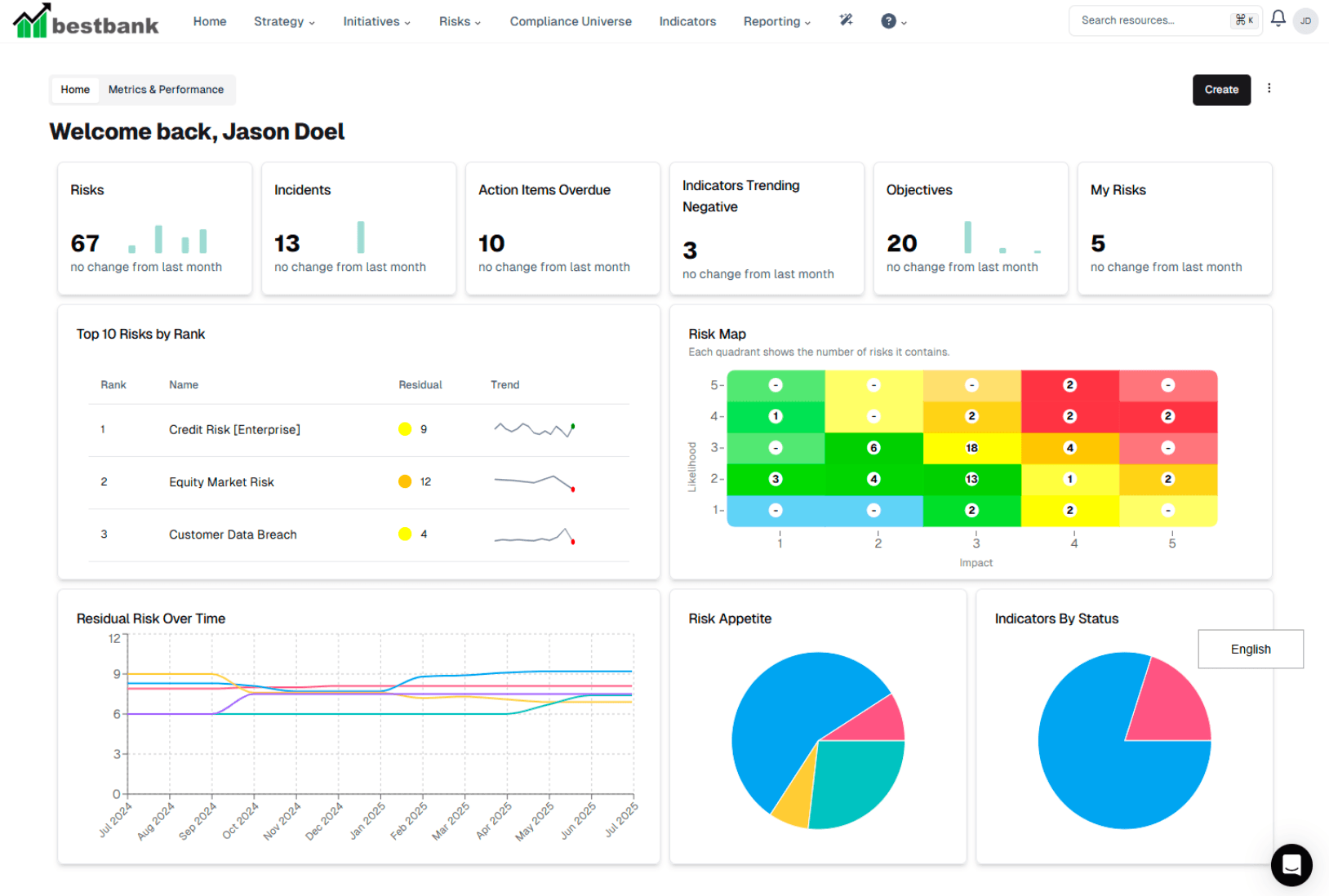
Organizations interested in evaluating Essential ERM in more detail can request a guided demo or hands-on trial to explore how objective-centric ERM works in practice.
AuditBoard
AuditBoard provides an integrated risk and compliance platform designed to unify risk screening, assessment, oversight, and related governance activities with audit and control workflows. Publicly available information describes AuditBoard's emphasis on real-time visibility into risk registers, scenario planning, dashboards, and strategic alignment across risk domains.
In ERM contexts, organizations often adopt AuditBoard where there is a need for structured enterprise-wide risk tracking closely tied to audit, control, and compliance functions. Its platform supports centralized risk data, scenario analysis, and integrations that help teams coordinate risk and assurance activities.
Based on publicly visible review data and themes observed on third-party platforms, customers typically highlight AuditBoard's comprehensive visibility into risk, strong reporting interfaces, and alignment with governance processes. Independent review sources also indicate high levels of customer satisfaction and recommendation scores.
Some organizations note that broader implementations that extend into multiple governance, risk, and compliance areas require thoughtful planning and alignment, particularly in large enterprise environments.
AuditBoard's Enterprise Risk Management solution can be a strong fit for organizations that require integrated risk, audit, and compliance capabilities within a unified platform.
MetricStream
MetricStream's Enterprise Risk Management solution is part of a broader governance, risk, and compliance (GRC) platform designed to help organizations systematically identify, assess, and manage risks across multiple domains. The product supports structured, multi-dimensional risk and control assessments, real-time insights, advanced analytics, dashboards, and visual reporting through heat maps, charts, and other interfaces.
In the context of ERM, MetricStream is often used by organizations seeking a comprehensive and integrated GRC framework that connects risk, compliance, controls, and reporting functions. Its enterprise-grade capabilities can support uniform risk assessment methodologies and detailed risk profiling at multiple organizational levels.
Based on publicly available product information and observed themes from third-party review platforms, customers highlight MetricStream's structured approach to risk assessment, extensive visualization and reporting tools, and its ability to centralize risk information and governance activities. Some organizations note that leveraging its depth and configurability may require significant planning and coordination.
MetricStream Enterprise Risk Management can be a strong fit for larger organizations with complex or highly regulated environments that value a centralized GRC platform capable of supporting broad risk and governance processes.
Workiva
Workiva is a connected reporting and risk platform that helps organizations unify data, documentation, and processes across financial reporting, compliance, and related governance functions. Its cloud-based environment is designed to support collaboration, audit trails, and version control, with configurable dashboards and reporting interfaces that help teams work together on complex compliance and risk-related workflows.
In the context of enterprise risk management, Workiva is often leveraged by organizations that prioritize collaboration across functions and centralized data that feeds into risk reporting and documentation. The platform's reporting strength and emphasis on connected data can support cross-functional visibility and tracking of risk-related metrics as part of wider governance processes.
Based on publicly available product information and observed themes from independent review platforms, customers commonly highlight Workiva's ease of collaboration, strong documentation and reporting tools, and flexibility in assembling reports and dashboards across different teams. Some reviews also note that achieving consistency across multiple modules may require governance and training to ensure enterprise-wide alignment, particularly where risk management spans decentralized functions.
Workiva can be a strong fit for organizations seeking an integrated environment for reporting, compliance, and cross-functional risk documentation, especially where unified data and collaborative workflows are priorities.
LogicGate
LogicGate Risk Cloud is a configurable governance, risk, and compliance (GRC) platform that aims to help organizations automate and manage risk, compliance, audit, and related governance workflows in a centralized environment. The solution uses a low-code/no-code framework designed to support tailored risk processes, automate manual tasks, and provide real-time visibility through dashboards and reporting.
In the context of enterprise risk management, LogicGate is frequently adopted by organizations that value flexibility in modelling risk processes and workflows. Its platform allows users to configure applications, streamline evidence collection, and build custom workflows that reflect their unique risk management approaches.
Based on publicly available product information and observed themes from third-party review platforms, customers often highlight LogicGate's flexibility, automation, and configurable workflows, which can support organizations in adapting the platform to varied risk and compliance needs. Many reviewers also note an intuitive interface and strong customer service, while some indicate that initial setup complexity and the need for thoughtful design can be part of the early implementation process.
LogicGate Risk Cloud can be a strong fit for organizations seeking a scalable and adaptable risk and governance platform that supports tailored workflows, cross-functional processes, and automated risk activities, particularly where integration with broader GRC and operational workflows is a priority.
Resolver
Resolver is a risk and incident management platform designed to support organizations in managing a broad range of risk, compliance, and assurance activities within a unified environment. The platform offers tools for risk assessment, incident and case management, control tracking, dashboards, and reporting designed to support visibility and coordination across risk programs.
In the context of enterprise risk management, Resolver is often used by organizations that value integrated incident and risk workflows, enabling teams to capture, analyze, and respond to risk-related events while maintaining a central repository of risk data. Its configuration flexibility and workflow capabilities support tailored risk processes and cross-functional coordination.
Based on publicly available product information and observed themes from third-party review platforms, customers frequently highlight Resolver's strength in customizable workflows, incident management integration, and visibility into risk trends. Reviewers also mention that the platform's reporting and dashboard capabilities can support enterprise-wide risk and compliance visibility, and that its flexible structure enables adaptation to diverse organizational needs. Some users note that initial setup and configuration benefit from planning and internal alignment to ensure consistent usage across functions.
Resolver can be a strong fit for organizations seeking a platform that combines risk, incident, and compliance workflows with customizable process automation and cross-functional visibility, particularly where incident-linked risk management and operational insights are priorities.
ServiceNow Integrated Risk Management (ServiceNow GRC)
ServiceNow Integrated Risk Management (IRM) is a cloud-native platform designed to help organizations connect risk, compliance, audit, and operational risk processes within the wider ServiceNow ecosystem. It emphasizes workflow automation, unified data models, and integration with other ServiceNow modules (such as IT Service Management and Security Operations) to support end-to-end risk and governance workflows.
In the context of enterprise risk management, ServiceNow IRM is often selected by organizations that prioritize integration across multiple risk and operational domains, particularly where risk and compliance activities are embedded within broader enterprise service management practices. Its design reflects a platform-centric approach that can leverage existing ServiceNow investments and support cross-functional process orchestration.
Based on publicly available product information and observed themes from third-party review platforms, customers frequently highlight ServiceNow IRM's ability to centralize risk processes within an organization's larger operational ecosystem, enabling automation of key workflows and visibility into risk and compliance activities. Reviewers also mention that the platform's strength lies in its integration and process consolidation, while some users note that configuration and customization can require careful planning and governance, particularly in contexts where organizations are extending the platform beyond operational risk into formal ERM practices.
ServiceNow Integrated Risk Management can be a strong fit for organizations that have already invested in the broader ServiceNow ecosystem and seek to unify risk, compliance, and operational processes in a single platform, especially where process integration and workflow automation across functions are priorities.
4. Side-by-side comparison of ERM Tools
The following comparison is based on a structured evaluation of leading ERM platforms using buyer-focused criteria and aggregated third-party review insights. To avoid oversimplification and misuse of licensed review data, detailed vendor-by-vendor scoring is shared directly with organizations evaluating ERM solutions, based on their specific context.
Structured side-by-side comparisons drawn from real evaluation criteria can help you see how platforms perform against your objectives. Connect with us to review comparisons tailored to your use case and get detailed vendor scoring.
Request a guided demo or comparison →5. Spotlight: Why buyers choose Essential ERM
Organizations evaluating ERM software in 2026 are often looking for more than comprehensive functionality. Many are seeking an approach to risk management that is practical, decision-oriented, and capable of engaging senior leaders in environments characterized by uncertainty and change. Essential ERM is frequently chosen by organizations that want ERM to inform strategy and governance directly, rather than operate as a check-box compliance or reporting function.
Designed for strategy-centric, executive-led ERM
A defining characteristic of Essential ERM is its objective-centric design. Risks are explicitly linked to strategic objectives, priorities, and outcomes, ensuring that ERM conversations remain grounded in what the organization is trying to achieve. This design supports alignment with ISO 31000 and COSO principles while helping boards and executives focus attention on the risks that matter most to strategic decision-making.
Visual models that support real scenario thinking
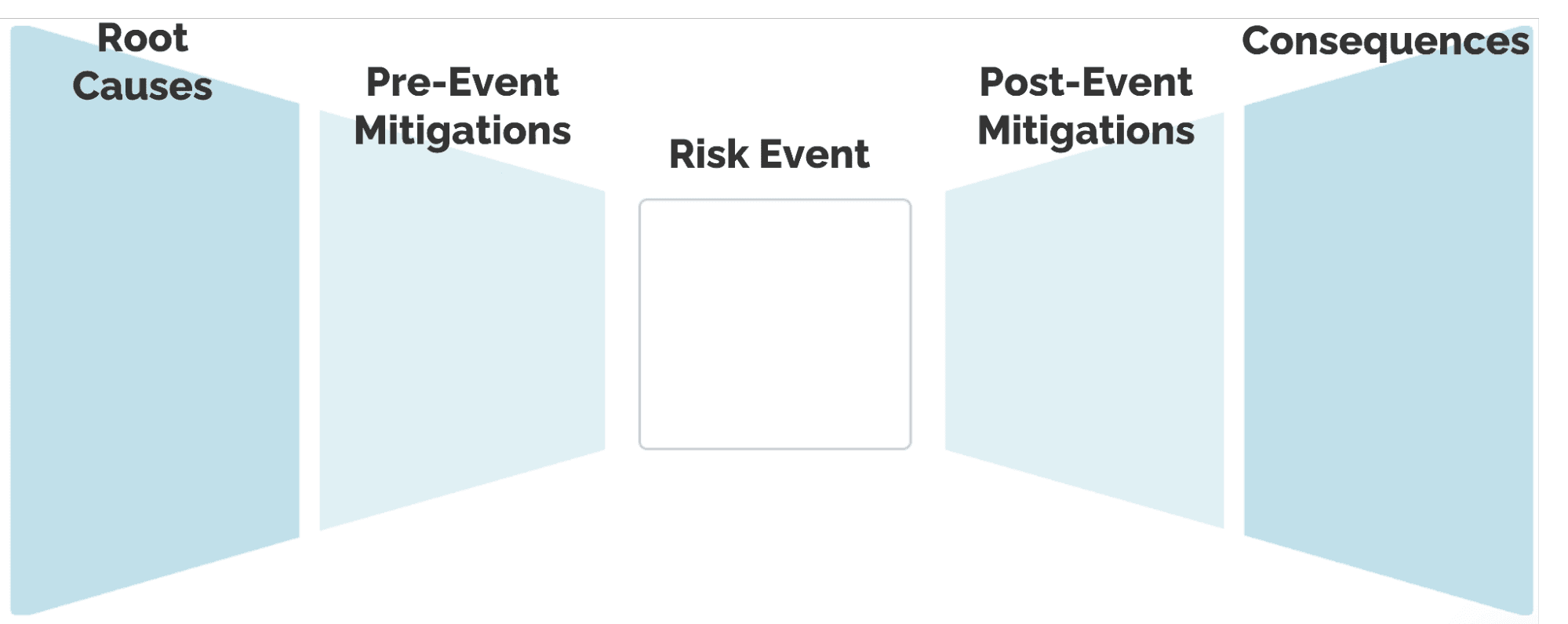
Essential ERM places strong emphasis on visual risk modelling to support understanding, discussion, and judgement. Features such as bow-tie diagrams allow organizations to clearly map causes, controls, and consequences, helping teams explore how risks may materialize and cascade under different scenarios. This approach supports practical scenario planning at a time when historical patterns are increasingly unreliable.
Faster insight through dynamic assessment and automation
Rather than relying on static registers and periodic assessments, Essential ERM supports dynamic risk assessment through capabilities such as automated risk voting and streamlined updates from across the organization. These tools help organizations capture changing risk perspectives efficiently and keep risk profiles current without creating additional administrative burden.
Practical performance monitoring through KRIs
Essential ERM also supports straightforward tracking of key risk indicators (KRIs), enabling organizations to monitor emerging risk signals and connect risk insights to operational and strategic performance. KRIs are designed to be easy to configure, understand, and maintain, supporting timely escalation and informed governance discussions.
Speed to value and ease of ongoing use
Many buyers choose Essential ERM for its speed and simplicity. The platform is designed to be implemented quickly and used effectively from day one, without lengthy configuration cycles. Ongoing administration and refinement can be handled by client teams, allowing organizations to adapt their ERM approach as strategies, structures, and risk profiles evolve—without turning ERM into a system-maintenance exercise.
Recognized by users for usability and adoption
Across independent third-party review platforms, users of Essential ERM consistently highlight ease of use, strong stakeholder engagement, and high overall satisfaction. These themes reflect the platform's focus on executive-ready design, clarity, and practical decision support rather than technical complexity.
For organizations seeking an ERM solution that supports strategy-aligned risk management, meaningful scenario analysis, and rapid time to value, Essential ERM represents a distinct alternative to traditional, compliance-centric GRC platforms.
Organizations interested in exploring Essential ERM further can request a guided demo or hands-on trial to evaluate how objective-centric ERM works in practice.
6. ERM tools by organization type
While the core principles of enterprise risk management are consistent across sectors, the way ERM is implemented — and the capabilities that matter most — can vary significantly by organization type. Regulatory environments, governance structures, operating models, and stakeholder expectations all influence what organizations should prioritize when selecting an ERM tool.
The following overview highlights common ERM considerations by organization type and the capabilities that tend to be most important in each context.
Financial institutions
Financial institutions typically operate under some of the most demanding regulatory and governance expectations. ERM tools in this sector must support disciplined risk assessment, ongoing monitoring, and strong linkage between risk, strategy, and performance.
- Integration of risk with strategic planning and capital decisions
- Dynamic risk assessment and timely escalation of emerging risks
- Clear ownership, accountability, and governance workflows
- Practical scenario analysis and stress-testing capabilities
- Strong auditability without excessive administrative burden
In this context, ERM tools that balance rigor with usability — and that can support executive decision-making rather than just regulatory reporting — are often preferred.
Public sector and government agencies
Public sector organizations often operate in highly visible, politically sensitive environments with complex accountability requirements. ERM tools in this context must support transparency, structured risk reporting, and alignment with strategic objectives, mandates, and public outcomes.
- Clear linkage between risks, strategic priorities, and public objectives
- Executive- and board-ready reporting for senior officials and oversight bodies
- Scenario analysis to support policy, funding, and service-delivery decisions
- Ease of use to support broad participation across departments
ERM platforms that emphasize clarity, visualization, and strategic alignment tend to perform well in public sector environments where engagement and explainability are critical.
Energy and utilities
Organizations in the energy and utilities sector face a mix of operational, regulatory, environmental, and strategic risks, often in asset-intensive and safety-critical environments. ERM tools must help organizations understand how risks interact across systems, projects, and external factors.
- Cause-and-impact modelling to understand cascading risks
- Scenario planning for regulatory change, supply disruption, and climate impacts
- Integration of operational risk insights into enterprise-level discussions
- Visualization tools to support cross-functional risk conversations
ERM platforms that support visual modelling and scenario-based thinking are particularly valuable where risk interdependencies are complex and consequences are material.
Education and not-for-profit organizations
Education institutions and not-for-profits often operate with limited resources, decentralized structures, and diverse stakeholder groups. ERM tools in these environments must be intuitive, adaptable, and aligned with mission-driven objectives rather than purely financial outcomes.
- Alignment of risks with institutional or mission objectives
- Ease of configuration and use without specialized resources
- Support for broad participation across faculties or programs
- Clear reporting for boards, donors, and oversight bodies
ERM tools that are easy to adopt, quick to implement, and focused on strategic relevance tend to gain stronger traction in these organizations.
Mid-market enterprises
Mid-market organizations often require ERM capabilities that are sophisticated enough to support growth and governance, but simple enough to avoid becoming a burden. ERM tools must deliver insight quickly and scale as the organization evolves.
- Fast implementation and low time-to-value
- Minimal reliance on technical specialists or heavy configuration
- Executive-ready dashboards and visualizations
- Flexibility to adapt as the organization grows or restructures
In this segment, ERM platforms that are purpose-built for usability and strategic focus — rather than enterprise-scale complexity — are often the most effective.
Choosing the right fit
Across all organization types, the most successful ERM implementations share a common theme: tools that align risk management with real decision-making tend to deliver the greatest value. Understanding how ERM needs differ by sector can help organizations narrow the field and focus on platforms that match their governance context, risk profile, and maturity.
7. Common mistakes when choosing ERM software
Selecting an ERM platform is a long-term decision that shapes how risk is understood, discussed, and acted upon across an organization. Many ERM initiatives struggle not because risk management lacks importance, but because the tools chosen do not match how organizations actually make decisions. The following are some of the most common pitfalls organizations encounter when evaluating ERM software.
Over-engineering the solution
One of the most frequent mistakes is selecting an ERM platform that is overly complex relative to the organization's needs and maturity. Tools designed for highly technical configuration or exhaustive data capture can slow adoption, increase administrative burden, and distract from insight generation.
ERM is most effective when it supports judgement and prioritization. Over-engineered systems often consume time maintaining the tool rather than improving decision-making, leading to frustration and eventual disengagement.
Buying audit or compliance tools and expecting ERM to follow
Many platforms originate from audit, compliance, or control-testing use cases. While these tools can be valuable in their intended domains, they do not always translate well to enterprise risk management.
ERM requires forward-looking thinking, strategic alignment, and engagement from executives and business leaders. Tools that are optimized for assurance activities may struggle to support scenario analysis, strategic risk discussions, or dynamic reassessment, resulting in ERM becoming a reporting exercise rather than a management discipline.
Focusing on checklists instead of insight
Another common pitfall is prioritizing feature checklists over how the tool actually supports decision-making. A long list of capabilities does not guarantee that risk information will be meaningful, timely, or actionable.
Effective ERM tools help organizations understand how risks interact, how they may evolve, and what they mean for strategic choices. Platforms that emphasize data entry and compliance artifacts without supporting interpretation and judgement often fail to deliver real value.
Ignoring change management and engagement
Even the most capable ERM software will fall short if people do not engage with it. Organizations sometimes underestimate the importance of usability, communication, and executive involvement when rolling out ERM tools. ERM platforms that are difficult to understand, overly technical, or disconnected from leadership priorities tend to be viewed as administrative burdens. Successful ERM implementations pair the right technology with thoughtful change management, clear ownership, and visible executive sponsorship.
Treating ERM as static in a dynamic environment
Finally, many organizations choose tools that assume risk can be assessed on a fixed annual or quarterly cycle. In periods of rapid change, static assessments quickly become outdated.
Modern ERM requires tools that support ongoing reassessment, scenario exploration, and timely updates as conditions evolve. Platforms built around static registers and infrequent reviews may struggle to keep pace with today's risk environment.
A practical takeaway
Avoiding these common mistakes starts with clarity about what ERM is meant to achieve. Organizations that focus on strategic relevance, usability, and decision support — rather than complexity or compliance alone — are more likely to build ERM programs that endure and deliver value.
8. How to choose the right ERM tool for your organization
Choosing an enterprise risk management tool in 2026 is less about finding the most feature-rich platform and more about selecting a system that fits how your organization makes decisions. ERM delivers value when it informs strategy, supports governance, and adapts as conditions change. The following practical steps can help organizations move from research to confident evaluation.
Step 1: Start with purpose, not software
Before comparing platforms, clarify what ERM is expected to achieve in your organization. This includes understanding how risk should support strategy, governance, performance, and decision-making — not just compliance or reporting.
Key questions to consider:
- How should ERM inform executive and board decisions?
- Which strategic objectives and outcomes should risks be linked to?
- How dynamic does risk assessment need to be in your environment?
Clear purpose helps narrow the field quickly and avoids selecting tools that are misaligned from the outset.
Step 2: Evaluate capabilities through real use cases
Rather than relying on feature lists, assess ERM platforms against realistic scenarios drawn from your organization. This might include a strategic initiative, a regulatory change, or an emerging operational risk.
Look for tools that:
- Make it easy to model cause-and-impact relationships
- Support scenario thinking and forward-looking analysis
- Provide executive-ready views without extensive translation
- Allow risk information to be updated efficiently as conditions evolve
Practical demonstrations using your own examples often reveal more than generic comparisons.
Step 3: Assess usability and engagement
ERM only works when people across the organization engage with it. Evaluate how intuitive the platform is for executives, managers, and risk owners — not just for specialists.
Consider:
- How quickly users can understand and interact with the system
- Whether the interface supports discussion and judgement, not just data entry
- The level of ongoing effort required to maintain and refine the system
Ease of use is not a "nice to have"; it is a critical determinant of long-term success.
Step 4: Consider implementation and adaptability
ERM tools should support evolution, not lock organizations into static models. Assess how quickly a platform can be implemented and how easily it can adapt as strategies, structures, and risks change.
Important factors include:
- Time to initial value
- Flexibility in organizational modelling
- Ability to reconfigure without major disruption
Tools that are difficult to adapt often struggle to remain relevant in dynamic environments.
Step 5: Validate fit through structured comparison
Once you've narrowed the field, compare platforms side-by-side using consistent, buyer-focused criteria. This helps move the evaluation from opinion to evidence and clarifies trade-offs.
Structured comparisons should focus on:
- Strategy alignment
- Scenario and visualization capabilities
- Executive readiness
- Ease of use and ongoing management
This is often where meaningful differences between platforms become clear.
A practical next step
Organizations evaluating ERM tools in 2026 benefit most from seeing how platforms perform against their own objectives and scenarios. Reviewing side-by-side comparisons and exploring tools through guided demonstrations can help translate research into informed decisions.
9. Executive takeaway
In 2026, effective ERM depends less on comprehensive checklists and more on tools that align risk with strategy, support forward-looking judgement, and engage leaders in real decision-making. Organizations that choose ERM platforms designed for clarity, adaptability, and insight are better positioned to navigate uncertainty and turn risk into a strategic advantage.
To explore how objective-centric, decision-oriented ERM works in practice, organizations can request a guided demo or hands-on trial of Essential ERM, or connect with us to review structured comparisons tailored to their specific use-case.




_BestMeetsRequirements_Mid-Market_MeetsRequirements.svg)
_BestSupport_Enterprise_QualityOfSupport.svg)
_BestSupport_Mid-Market_QualityOfSupport.svg)
_BestSupport_QualityOfSupport.svg)
_BestUsability_Mid-Market_Total.svg)
_EasiestAdmin_EaseOfAdmin.svg)
_EasiestAdmin_Enterprise_EaseOfAdmin.svg)
_EasiestAdmin_Mid-Market_EaseOfAdmin.svg)
_EasiestSetup_EaseOfSetup.svg)
_EasiestSetup_Mid-Market_EaseOfSetup.svg)
_EasiestToDoBusinessWith_EaseOfDoingBusinessWith.svg)
_EasiestToDoBusinessWith_Enterprise_EaseOfDoingBusinessWith.svg)
_EasiestToDoBusinessWith_Mid-Market_EaseOfDoingBusinessWith.svg)
_EasiestToUse_Enterprise_EaseOfUse.svg)
_EasiestToUse_Mid-Market_EaseOfUse.svg)
_FastestImplementation_Mid-Market_GoLiveTime.svg)
_HighPerformer_Enterprise_HighPerformer.svg)
_HighPerformer_HighPerformer.svg)
_HighPerformer_Mid-Market_HighPerformer.svg)
_HighestUserAdoption_Mid-Market_Adoption.svg)
_MostImplementable_Mid-Market_Total.svg)
_UsersMostLikelyToRecommend_Mid-Market_Nps.svg)