
1. Introduction: Why compliance management looks different in 2026
In 2026, compliance management is operating in an environment of growing complexity. Organizations are navigating expanding regulatory obligations in some areas, deregulatory signals in others, and increasing divergence across jurisdictions. For many businesses, compliance is shaped by cross-currents, where rules, expectations, and enforcement priorities are moving in different directions at once.
"The regulatory landscape is undergoing a complex recalibration… The result is a more fragmented regulatory and supervisory environment as authorities pursue their own objectives and global coordination recedes."
At the same time, boards, regulators, and stakeholders continue to raise expectations around accountability, transparency, and oversight. Even where formal requirements are being streamlined or relaxed, organizations are often expected to demonstrate control, governance, and resilience—particularly in regulated sectors and cross-border operations. As a result, compliance is no longer confined to a single function or periodic review process; it has become an ongoing, organization-wide discipline.
Traditional approaches to compliance management are increasingly strained in this environment. Spreadsheet-based tracking, siloed ownership of obligations, and point-in-time assessments often struggle to keep pace with regulatory divergence and shifting expectations. When compliance requirements evolve unevenly across jurisdictions, static and document-centric approaches can obscure risk rather than clarify it.
In this context, a compliance management system plays a critical role in helping organizations move from reactive, fragmented compliance efforts to a more proactive, structured and sustainable approach. Modern compliance management systems support clearer ownership of obligations, consistent implementation of controls, ongoing monitoring, and executive-level oversight—allowing compliance to function as an integrated part of governance rather than a standalone administrative exercise.
This guide explains what a compliance management system is, how it works in practice, and what organizations should consider when evaluating modern compliance management approaches in 2026.
2. What is a compliance management system (CMS)?
A compliance management system (CMS) is a structured approach—supported by people, processes, and technology—that helps an organization identify its regulatory and policy obligations, implement appropriate controls, monitor compliance on an ongoing basis, and respond effectively when issues arise.
Importantly, a CMS is not just software. It encompasses the governance structures, accountability models, workflows, and information needed to ensure compliance expectations are understood, managed, and overseen consistently across the organization.
Beyond compliance as documentation
In practice, many organizations historically treated compliance as a documentation exercise: maintaining policies, completing periodic reviews, and responding to audits or regulatory requests as they occurred. While documentation remains necessary, it is no longer sufficient in an environment characterized by regulatory divergence and frequent change.
A modern compliance management system shifts the focus from static artifacts to continuous management. It emphasizes clear ownership of obligations, consistent application of controls, and timely visibility into compliance status, so organizations can identify emerging issues early rather than react after the fact.
A system for coordination and accountability
At its core, a CMS provides a coordinated way to manage compliance responsibilities across functions, business units, and jurisdictions. It helps answer fundamental questions such as:
- What obligations apply to the organization, and where?
- Who is accountable for meeting them?
- What controls are in place to manage compliance risk?
- How is compliance being monitored, and with what results?
- How are issues identified, escalated, and resolved?
By providing a common structure and shared view of compliance activities, a CMS reduces reliance on informal knowledge, manual tracking, and siloed processes.
How a CMS fits into governance and risk
While a compliance management system focuses on meeting regulatory and policy requirements, it increasingly operates as part of a broader governance and risk ecosystem. Compliance obligations often introduce risk exposure, influence strategic decisions, and shape stakeholder expectations.
For this reason, modern CMS implementations are designed to support executive oversight, board reporting, and alignment with enterprise risk management and governance processes—ensuring compliance insights inform decision-making rather than remaining isolated within a single function.
Why definitions matter in 2026
In a period where regulatory requirements may tighten in one jurisdiction while loosening in another, clarity around what constitutes a compliance management system is essential. Organizations that treat compliance as an ad hoc or purely administrative activity often struggle to adapt when expectations shift. By contrast, organizations that implement compliance as a managed system—one that supports visibility, accountability, and adaptability—are better positioned to navigate regulatory cross-currents and demonstrate control, resilience, and good governance, with research showing that businesses transforming compliance functions report far higher preparedness in the face of disruption than those maintaining traditional approaches (EY).
3. Core components of an effective compliance management system
While compliance requirements vary by industry, jurisdiction, and organization size, effective compliance management systems tend to share a common set of foundational components. These components work together to create consistency, accountability, and visibility—particularly important in environments characterized by regulatory divergence and change.
Governance and accountability
An effective CMS begins with clear governance. This includes defined ownership of compliance responsibilities, escalation pathways, and oversight structures that extend beyond the compliance function itself. Roles and responsibilities should be explicit, understood, and supported by senior leadership to ensure compliance expectations are taken seriously across the organization. Strong governance helps prevent compliance from becoming fragmented or reactive, and supports consistent decision-making when issues arise.
Regulatory and policy obligations management
Organizations must first understand what they are required to comply with. This involves maintaining a current inventory of applicable laws, regulations, standards, and internal policies across jurisdictions and business activities. A mature CMS supports ongoing identification and review of obligations, rather than relying on static lists or periodic updates. This is especially important where regulatory requirements evolve unevenly across regions or sectors.
Controls and implementation
Once obligations are identified, they must be translated into practical controls—policies, procedures, processes, and activities designed to ensure compliance in day-to-day operations. Effective CMS implementations focus on consistency and clarity in how controls are defined and applied. Clear linkage between obligations and controls helps organizations demonstrate not only that requirements are understood, but that they are actively managed.
Monitoring and testing
Ongoing monitoring is essential to understanding whether compliance controls are working as intended. This may include self-assessments, key control checks, internal reviews, or other forms of validation appropriate to the organization's risk profile. In contrast to point-in-time reviews, continuous or periodic monitoring enables earlier identification of gaps, reducing the likelihood of compliance issues escalating into regulatory findings or operational disruption.
Issue management and remediation
No compliance program is perfect. An effective CMS provides a structured way to capture issues, assess their impact, assign accountability, and track remediation through to completion. Transparent issue management supports learning and improvement, and helps demonstrate to regulators and stakeholders that compliance concerns are taken seriously and addressed systematically.
Reporting and oversight
Compliance information must be communicated in a way that supports oversight and decision-making. This includes reporting tailored to different audiences, from operational teams to senior management and boards. Clear, concise reporting helps move compliance discussions beyond activity tracking toward judgement, prioritization, and informed action.
Alignment with risk and strategic objectives
Increasingly, organizations are linking compliance management to broader risk and strategy considerations. Compliance obligations often introduce or mitigate risks that affect strategic objectives, reputation, and long-term performance. A CMS that supports this alignment enables compliance teams to provide context on how regulatory requirements intersect with business priorities, helping elevate compliance from a purely operational function to a contributor to governance and strategic decision-making.
Callout: Elevating compliance through strategic alignment
Increasingly, compliance leaders are expected to demonstrate how regulatory obligations connect to broader organizational priorities rather than operating as a standalone control function. Regulatory requirements often introduce risks, constraints, or dependencies that directly affect strategic initiatives, reputation, and long-term performance.
When compliance obligations are linked to strategic objectives, organizations gain clearer visibility into why specific requirements matter, how compliance supports business outcomes, and where regulatory exposure could threaten key priorities. This alignment helps shift compliance conversations from activity tracking toward prioritization, trade-offs, and informed decision-making—particularly at the executive and board level.
This perspective is reflected in international best practice. ISO 37301: Compliance Management Systems emphasizes aligning compliance activities with organizational objectives and governance structures, reinforcing the role of compliance as an integral part of leadership, oversight, and decision-making rather than a purely administrative function.
As expectations around governance and oversight continue to rise, organizations that position compliance within the context of strategy are better able to demonstrate relevance, secure engagement from senior leaders, and integrate compliance insights into enterprise decision processes.
4. How compliance management fits into risk and governance
While compliance management focuses on meeting regulatory and policy requirements, it does not operate in isolation. Compliance obligations introduce risk exposure, influence operational decisions, and shape governance expectations across the organization. For this reason, compliance management is increasingly understood as a core component of enterprise risk management and governance rather than a standalone control function.
Compliance risk as part of enterprise risk
From a risk perspective, compliance risk represents the potential for legal, regulatory, financial, or reputational consequences arising from failure to meet obligations. These risks are rarely confined to compliance alone. They often intersect with operational, strategic, financial, and reputational risks, particularly in regulated or highly visible sectors. Treating compliance risk as a subset of enterprise risk allows organizations to assess regulatory exposure in context—understanding not only whether an obligation exists, but how failure to meet it could affect broader objectives and outcomes.
From obligations to residual risk
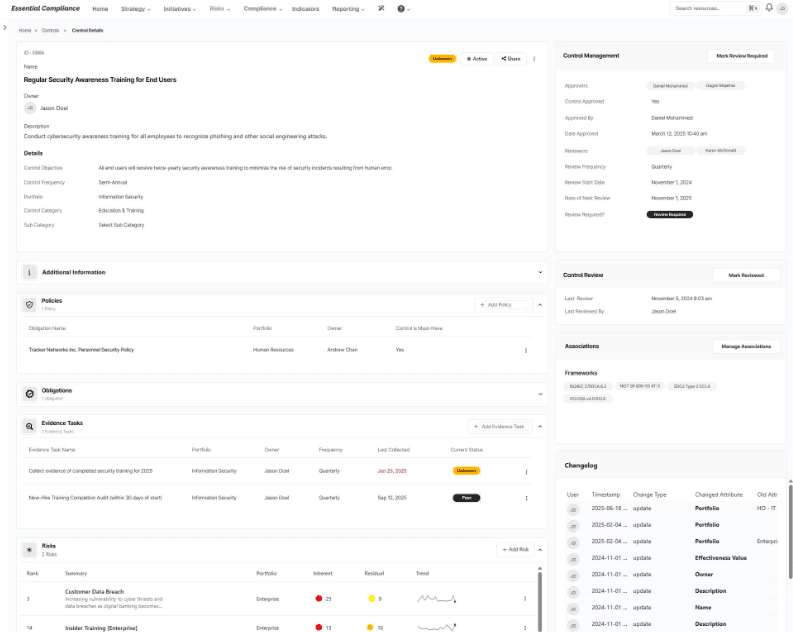
An effective governance model connects compliance activities through a clear chain of logic:
Obligations → controls → effectiveness → residual risk
This progression helps organizations move beyond binary compliance status toward a more nuanced understanding of exposure. It enables leaders to see where controls are strong, where gaps exist, and where residual risk remains—supporting informed prioritization and decision-making. Without this linkage, compliance information often remains fragmented, making it difficult for executives and boards to assess the true level of regulatory risk facing the organization.
Board and executive expectations
Boards and senior leaders increasingly expect compliance insights that support oversight, judgement, and accountability—not just reports confirming activity completion. They want to understand where regulatory exposure is concentrated, how it is being managed, and how it could affect strategic priorities. When compliance management feeds into governance and risk discussions, it supports more meaningful oversight and helps ensure regulatory considerations are factored into planning, investment, and operational decisions.
Integrating compliance with ERM and governance processes
In response to regulatory complexity and rising expectations, many organizations are integrating compliance management more closely with enterprise risk management and governance processes. This integration allows regulatory exposure to be assessed alongside other risks, supports consistent reporting and escalation, and helps avoid duplication of effort across functions. Rather than operating as a parallel system, a well-designed CMS contributes to a unified view of risk and governance—ensuring compliance insights inform enterprise decision-making in a structured and consistent way.
5. Common challenges with traditional compliance management approaches
Many of the challenges organizations face with compliance management stem from approaches that were designed for a more stable and predictable regulatory environment. As regulatory expectations increase and diverge, these traditional models can limit visibility, strain resources, and reduce the effectiveness of compliance efforts. The table below highlights common patterns seen across organizations and why they become problematic in practice.
| Traditional approach | What it looks like in practice | Why it becomes a problem | Impact |
|---|---|---|---|
| Spreadsheet-driven compliance | Obligations and controls tracked across multiple spreadsheets owned by different teams | Manual updates, version control issues, and reliance on individual knowledge limit scalability | Reduced visibility, higher operational risk, and difficulty demonstrating consistency |
| Siloed ownership | Compliance activities managed independently by functions or regions | Inconsistent interpretations and duplicated effort across the organization | Gaps in coverage and fragmented reporting to leadership |
| Point-in-time reviews | Annual or periodic compliance assessments | Static snapshots do not reflect changing requirements or emerging risks | Delayed response to regulatory change and increased exposure |
| Ad hoc regulatory tracking | Informal monitoring of regulatory changes | Emerging obligations may be missed or assessed too late | Reactive compliance and compressed implementation timelines |
| Compliance as reporting | Focus on documenting activity rather than outcomes | Limited executive engagement and oversight | Compliance perceived as administrative rather than strategic |
Individually, these challenges can reduce efficiency and increase risk. Collectively, they make it difficult for organizations to adapt as regulatory expectations shift. Addressing them typically requires moving beyond traditional tools and point-in-time processes toward compliance management approaches designed for visibility, coordination, and change. These limitations help explain why organizations are increasingly re-examining what they need from a modern compliance management system.
6. What to look for in a modern compliance management system
As organizations move beyond traditional compliance approaches, the focus shifts from documenting activity to enabling visibility, coordination, and informed decision-making. A modern compliance management system should support this shift by addressing the structural challenges outlined above while remaining adaptable as regulatory expectations evolve. The following capabilities reflect what organizations should prioritize when evaluating compliance management systems in 2026.
| Capability | What it means in practice | Why it matters |
|---|---|---|
| Centralized obligations management | A single, structured view of applicable laws, regulations, standards, and internal policies across jurisdictions | Reduces fragmentation and ensures compliance requirements are consistently understood and applied |
| Clear linkage between obligations, controls, and risk | Explicit connections showing how requirements are implemented and what exposure remains | Enables more meaningful assessment of compliance risk and supports governance and oversight |
| Continuous monitoring and visibility | Ongoing insight into compliance status rather than reliance on periodic reviews | Supports earlier identification of gaps and reduces reliance on reactive remediation |
| Executive-ready reporting | Clear, concise reporting tailored for senior management and boards | Improves engagement, oversight, and prioritization of compliance risks |
| Alignment with governance and strategy | Ability to relate compliance obligations to organizational priorities and objectives | Helps elevate compliance from an operational activity to a contributor to decision-making and governance |
| Ease of configuration and maintenance | Straightforward setup and ongoing refinement without heavy reliance on specialists | Supports faster time to value and sustained adoption as requirements change |
| Scalability across jurisdictions and regulations | Ability to manage multiple regulatory regimes within a consistent framework | Essential for organizations operating across regions or sectors with divergent requirements |
How these capabilities fit together
Individually, each capability addresses a specific limitation of traditional compliance management. Together, they enable a more resilient and adaptable approach—one that supports regulatory change, improves transparency, and strengthens governance. Organizations evaluating compliance management systems in 2026 benefit from assessing not only whether these capabilities exist, but how well they work together to support real-world compliance operations.
7. Compliance management across organization types
While the fundamentals of compliance management are consistent, the pressures, expectations, and complexity organizations face vary significantly by sector. An effective compliance management system must be adaptable enough to reflect these differences while providing a consistent foundation for governance and oversight. The following examples illustrate how compliance management requirements commonly differ across organization types.
Financial institutions
Financial institutions operate in one of the most highly regulated environments, often subject to overlapping prudential, conduct, consumer protection, and operational resilience requirements. Compliance expectations are shaped by frequent regulatory updates, supervisory scrutiny, and strong governance obligations at the board level. For these organizations, effective compliance management requires rigorous obligations tracking, strong linkage between requirements and controls, and clear reporting that supports executive oversight and regulatory engagement. Scalability and consistency across business lines and jurisdictions are especially critical.
Public sector and agencies
Public sector organizations face compliance obligations related to legislation, policy directives, procurement, data protection, and accountability frameworks. Transparency, auditability, and public trust are central concerns, often alongside constrained resources. Compliance management approaches in this context must support clear ownership, defensible processes, and accessible reporting, while remaining practical for diverse stakeholders and operating models.
Energy and utilities
Energy and utilities organizations manage complex compliance requirements spanning safety, environmental protection, reliability, and infrastructure oversight. Regulatory expectations can vary by geography and are often subject to heightened scrutiny during incidents or disruptions. An effective CMS in this sector supports visibility across operational and regulatory domains, helps manage evolving requirements, and enables proactive identification of compliance risks tied to critical assets and services.
Education and not-for-profit organizations
Educational institutions and not-for-profit organizations face a mix of regulatory, funding, governance, and policy-driven compliance obligations. These organizations often balance compliance responsibilities alongside decentralized operations and limited administrative capacity. Compliance management systems must therefore emphasize clarity, usability, and coordination, enabling consistent application of requirements without creating undue administrative burden.
Growing and mid-market enterprises
Mid-market and growing organizations often experience compliance complexity increasing faster than their internal structures evolve. As they expand into new markets or regulatory regimes, informal or manual compliance approaches may no longer scale effectively. For these organizations, compliance management systems that are straightforward to implement and adapt can help establish strong foundations early, reducing risk and avoiding costly rework as the organization grows.
Why sector context matters
Understanding how compliance pressures differ by organization type helps ensure compliance management systems are fit for purpose. Systems that are too rigid or overly complex may struggle to gain adoption, while those that lack structure may fail to support oversight as expectations rise. Recognizing sector-specific needs allows organizations to evaluate compliance management approaches that balance consistency with flexibility—an important consideration when moving from research to selection.
8. When does compliance software become necessary?
Not every organization requires dedicated compliance management software from the outset. In smaller or less regulated environments, manual processes and informal coordination may be sufficient. However, as regulatory obligations expand and expectations around governance increase, many organizations reach a point where traditional approaches no longer scale effectively. Several common signals indicate when it may be time to consider purpose-built compliance management software.
Manual tracking no longer scales
As the number of applicable regulations, policies, and jurisdictions grows, spreadsheets and shared documents become increasingly difficult to maintain. Version control issues, reliance on individual knowledge, and manual updates can introduce risk and reduce confidence in compliance information. When significant time is spent maintaining tracking artifacts rather than managing compliance outcomes, software support often becomes necessary.
Multiple overlapping regulatory requirements
Organizations subject to multiple regulators or operating across jurisdictions frequently face overlapping or interconnected requirements. Managing these relationships manually can lead to duplicated effort, inconsistent interpretation, and gaps in coverage. Compliance software can help centralize obligations and clarify how requirements relate to one another, improving efficiency and consistency.
Increased findings, issues, or remediation cycles
Recurring audit findings, regulatory observations, or extended remediation timelines often indicate structural weaknesses in compliance management. These patterns may reflect limited visibility into control effectiveness or delayed identification of emerging issues. Dedicated compliance systems support more proactive monitoring and issue management, reducing the likelihood of repeat findings.
Growing demand for executive and board visibility
As compliance becomes more closely tied to governance and risk oversight, boards and senior leaders increasingly request clear, timely insight into compliance posture. Producing executive-ready reporting from manual systems can be time-consuming and error-prone. Compliance management software can provide more consistent and accessible views that support informed oversight and decision-making.
Expansion into new markets or regulatory regimes
Growth through expansion, acquisition, or diversification often introduces new compliance obligations that strain existing processes. Without a scalable system, organizations may struggle to integrate new requirements effectively. Implementing compliance software at this stage can help establish a structured foundation that supports continued growth and regulatory change.
From recognition to evaluation
Recognizing these signals does not automatically dictate a specific solution, but it often prompts organizations to reassess how compliance is managed. At this stage, many begin evaluating modern compliance management platforms to determine whether they can provide the visibility, coordination, and adaptability needed to support evolving expectations. This transition marks a shift from managing compliance activities to managing compliance as a proactive and continuous system—an important distinction as organizations move from research toward informed evaluation.
9. A practical next step
Organizations evaluating compliance management approaches in 2026 benefit most from seeing how concepts translate into practice. Definitions, frameworks, and capability lists provide important context, but real clarity often comes from understanding how obligations, controls, risks, and reporting work together within a single system.
For many organizations, this means exploring whether a modern compliance management platform can support their specific regulatory environment, governance expectations, and strategic priorities. Solutions that integrate compliance with enterprise risk management and strategic planning can help ensure compliance efforts remain relevant, decision-focused, and aligned with how the organization is governed.
Organizations interested in exploring this approach further can request a guided demo or hands-on trial of Essential Compliance to see how a modern, integrated compliance management system works in practice.
10. Executive takeaway
In 2026, effective compliance management requires more than documenting obligations—it demands systems that provide visibility, accountability, and adaptability in the face of regulatory divergence and change. Organizations that treat compliance as an integrated part of governance, risk, and strategic decision-making are better positioned to navigate complexity and build long-term resilience.





_BestMeetsRequirements_Mid-Market_MeetsRequirements.svg)
_BestSupport_Enterprise_QualityOfSupport.svg)
_BestSupport_Mid-Market_QualityOfSupport.svg)
_BestSupport_QualityOfSupport.svg)
_BestUsability_Mid-Market_Total.svg)
_EasiestAdmin_EaseOfAdmin.svg)
_EasiestAdmin_Enterprise_EaseOfAdmin.svg)
_EasiestAdmin_Mid-Market_EaseOfAdmin.svg)
_EasiestSetup_EaseOfSetup.svg)
_EasiestSetup_Mid-Market_EaseOfSetup.svg)
_EasiestToDoBusinessWith_EaseOfDoingBusinessWith.svg)
_EasiestToDoBusinessWith_Enterprise_EaseOfDoingBusinessWith.svg)
_EasiestToDoBusinessWith_Mid-Market_EaseOfDoingBusinessWith.svg)
_EasiestToUse_Enterprise_EaseOfUse.svg)
_EasiestToUse_Mid-Market_EaseOfUse.svg)
_FastestImplementation_Mid-Market_GoLiveTime.svg)
_HighPerformer_Enterprise_HighPerformer.svg)
_HighPerformer_HighPerformer.svg)
_HighPerformer_Mid-Market_HighPerformer.svg)
_HighestUserAdoption_Mid-Market_Adoption.svg)
_MostImplementable_Mid-Market_Total.svg)
_UsersMostLikelyToRecommend_Mid-Market_Nps.svg)